

Hot summer days can feel very different depending on where you are in Salem. A shady park or tree-lined neighborhood can offer some relief, while areas surrounded by pavement, buildings, and limited tree cover can become much warmer.
This summer, Willamette University students, faculty, and staff partnered with the City of Salem and Marion County to better understand those differences and help our community prepare for extreme heat. Through hands-on research, public education, and heat mapping, the project is helping local leaders gather information that could guide future decisions about trees, cooling resources, and other ways to keep Salem residents safer during hot weather.
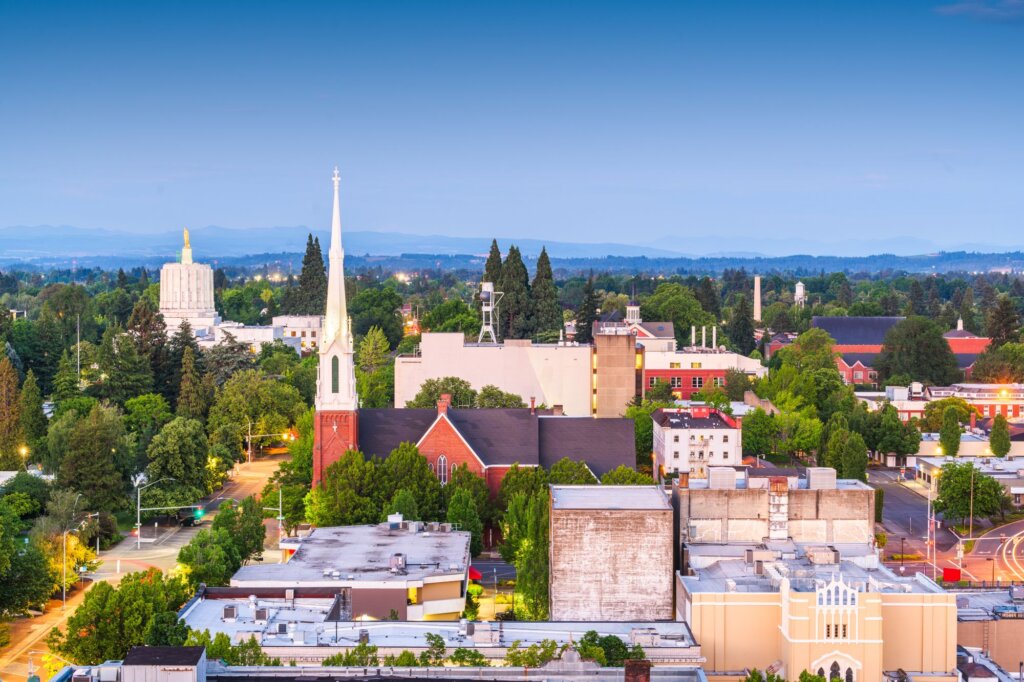
Understanding Heat Across Salem and Marion County
Extreme heat is an important concern throughout the Mid-Willamette Valley. According to Willamette University, Marion County is Oregon’s fourth most vulnerable county to extreme heat. Hot weather can be especially challenging for people who work outdoors, residents without air conditioning, and others who may be more vulnerable to heat-related illness.
As part of the City-sponsored Heat Watch project, researchers and volunteer “street scientists” traveled throughout Marion County to measure temperatures in different locations and at different times of day. Their work will contribute to Marion County’s first-ever heat map, providing a more detailed picture of how extreme heat affects different parts of our local community.
Willamette faculty also conducted additional measurements using Kestrel 5400 heat stress trackers, which are handheld devices commonly used to monitor potentially unsafe heat conditions. The university plans to use this information for additional research and to better understand heat exposure in places such as parks, agricultural areas, and fields where farmworkers spend their workdays.
Turning Local Research Into Local Solutions
The information collected through Heat Watch will support the City of Salem’s Climate Action Plan and Marion County’s Climate and Health Adaptation Plan. Local leaders may be able to use the findings to help determine where strategies like tree planting and targeted cooling resources could have the greatest impact.
By collecting information directly throughout the community, researchers can gain a better understanding of how heat conditions vary from one Salem-area location to another.
Helping Families Learn About Extreme Heat
Willamette’s involvement also included community education.
At the Marion County Heat Awareness & Resource Fair, Willamette students, faculty, and staff helped families learn about the urban heat island effect and how shade can make a difference. Children even had the opportunity to use infrared thermometers during an educational scavenger hunt, comparing temperatures around the built environment and seeing firsthand how different surfaces respond to summer heat.
This simple activity conveyed an important message, which is that the places we build, plant, and protect can influence how comfortable (and safe) our neighborhoods are during extreme weather.
Salem Students Putting Research Into Action
For Willamette University students, the project is also an opportunity to take learning beyond campus. Students worked alongside faculty, local government agencies, community members, and volunteers while contributing to research with real-world applications. That hands-on experience demonstrates how local education and community partnerships can work together to address challenges right here in Salem.
As researchers continue analyzing the information collected this summer, their work could help Salem and Marion County better understand where extreme heat has the greatest impact and how future resources can be directed where they’re needed most.
It’s another great example of what can happen when local organizations collaborate for the good of the community, and also how research happening right here in Salem can help make our neighborhoods safer and more resilient.