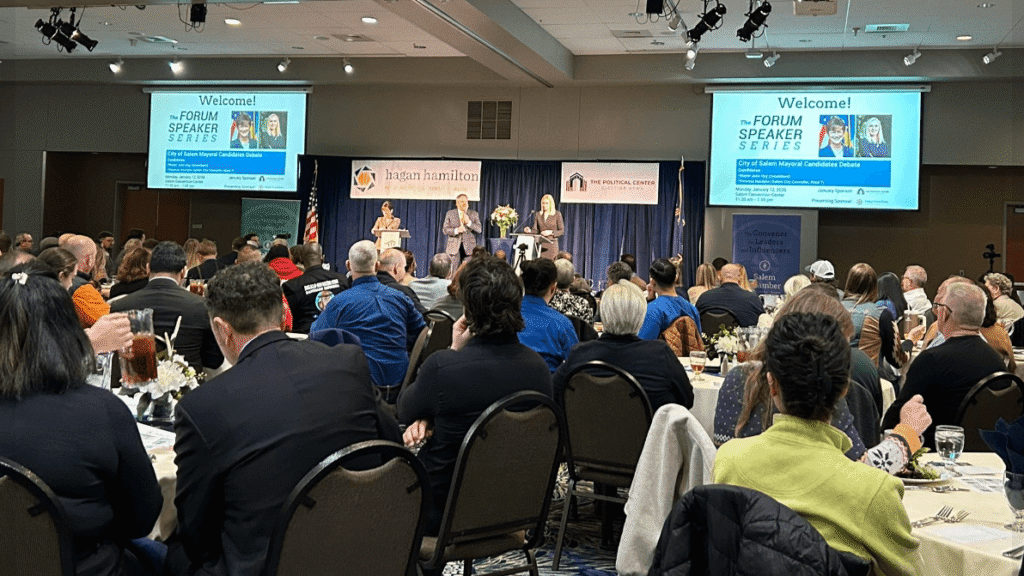
The business community and local residents packed a recent Salem mayoral forum hosted by the Salem Area Chamber of Commerce to hear directly from Julie Hoy, the city’s incumbent mayor, and Vanessa Nordyke, a current city councilor, as the two candidates debated the future of Salem.
The event covered a broad range of topics, including homelessness, public safety, housing, business regulation, transportation, city finances, and ethics in government. While moments of sharp disagreement surfaced, the forum also revealed areas of notable overlap between the two candidates.
Opening Visions: Stability vs. Leadership Style
Mayor Hoy opened the forum by highlighting what she described as a significant financial turnaround during her first year in office.
According to Hoy, Salem’s five-year financial forecast initially projected a $23.4 million deficit in 2026. Following a citizen-led financial forecast review, that deficit was reduced to $17.7 million. Further adjustments based on efficiency review team recommendations brought the projected shortfall down to $13.8 million.
Hoy said the passage of the 2025 Livability Levy, approved by voters, ultimately shifted the forecast to a $3.9 million positive fund balance for 2026. She credited city staff, council collaboration, and cross-department coordination, including support for the library, parks, and senior services, for the rapid turnaround.
She also referenced her participation in national and international mayoral leadership programs through Bloomberg and Harvard, noting that Salem’s financial and public safety challenges mirror those faced by cities across the country.
Councilor Nordyke followed with an opening statement focused on her lifelong ties to Salem and decades of civic involvement. She framed the mayor’s role as an underutilized leadership position and argued that the city’s challenges, particularly housing affordability, homelessness, and public safety, require more visible and proactive leadership.
Homelessness and Public Safety
Homelessness, addiction, and mental health dominated much of the discussion.
Both candidates agreed that no one should be living on Salem’s streets and that enforcement alone is insufficient. However, their approaches diverged:
- Hoy stressed accountability, sanitation, and cleanup efforts, citing firsthand experiences with downtown disorder and encampments. She emphasized expanding homeless services teams and pressing state agencies, particularly ODOT, to act more quickly on encampments located on state property.
- Nordyke focused on long-term pathways out of homelessness, highlighting crisis response teams staffed by medical and mental health professionals, youth shelters, and stronger coordination with service providers. She warned that displacement without adequate shelter options simply shifts the problem elsewhere.
Taxes, Transit, and Affordability
On fiscal issues, the candidates found rare and repeated agreement.
Both firmly opposed:
- New payroll taxes
- The proposed Cherriots employer payroll tax
- Any new taxes or fees on Salem businesses in the next 18 months
Nordyke emphasized that major tax proposals should go before voters, while Hoy argued that the city must prioritize existing crises before considering new revenue tools.
Business Climate and Economic Development
Responding to concerns about Oregon’s reputation as a difficult place to do business, both candidates acknowledged frustration from local employers.
Nordyke proposed:
- Ending downtown business parking assessments now that paid parking is generating revenue
- Simplifying signage rules and business regulations
- Recruiting businesses relocating from Portland
Hoy agreed on the need to reduce red tape and supported refunding downtown parking assessments, noting that paid parking has improved access and revenue. She stressed continuity and expressed confidence in the city’s current administrative leadership.
Housing and Growth
Housing affordability was another shared concern.
Both candidates said Salem needs a full range of housing types, from low-income to market-rate homes, and agreed that regulations should be streamlined to speed development.
Nordyke pointed to recent rezoning efforts and the city’s Housing Production Strategy as progress already underway. Hoy emphasized that state-level regulations often slow development and called for legislative changes to remove barriers.
Ethics and Governance
The sharpest exchange of the debate came during questions about ethics and past council decisions involving campaign donors and a state ethics investigation.
Nordyke argued that the investigation demonstrated a need for clearer ethical standards and greater accountability. Hoy defended her actions as legally appropriate, saying she followed city attorney guidance and did not personally benefit.
The exchange highlighted a philosophical divide over perceptions of ethics, even as both candidates stated they value transparency.
Downtown, Transportation, and Infrastructure
On transportation and street redesigns, neither candidate supported making large-scale road diets or bike lane expansions a top spending priority at this time. Both emphasized focusing limited resources on safety, cleanliness, and core services.
Paid parking downtown drew mixed reactions, with Hoy reporting mostly positive feedback from businesses and patrons, while Nordyke said she wants to review survey data and continue gathering public input.
Looking Ahead
Asked about the city’s direction over the next four years, both candidates emphasized economic vitality as essential to Salem’s future. Hoy framed her vision as building on recent progress, while Nordyke argued that affordability challenges show the need for course correction and stronger leadership.
Despite moments of tension, the forum revealed substantial agreement on taxes, housing supply, and the need to support local businesses, leaving voters to weigh differences in leadership style, priorities, and approach as the election approaches.
##