
One of Salem’s most critical infrastructure projects—the seismic retrofit of the Center Street Bridge—is nearing its construction phase. The multi-year effort, led by the Oregon Department of Transportation (ODOT), is scheduled to begin major construction work in mid-2026.
Its purpose is not merely structural but existential: to make sure at least one Willamette River crossing remains operational for emergency response after a major Cascadia Subduction Zone earthquake (commonly referred to as “The Big One”).
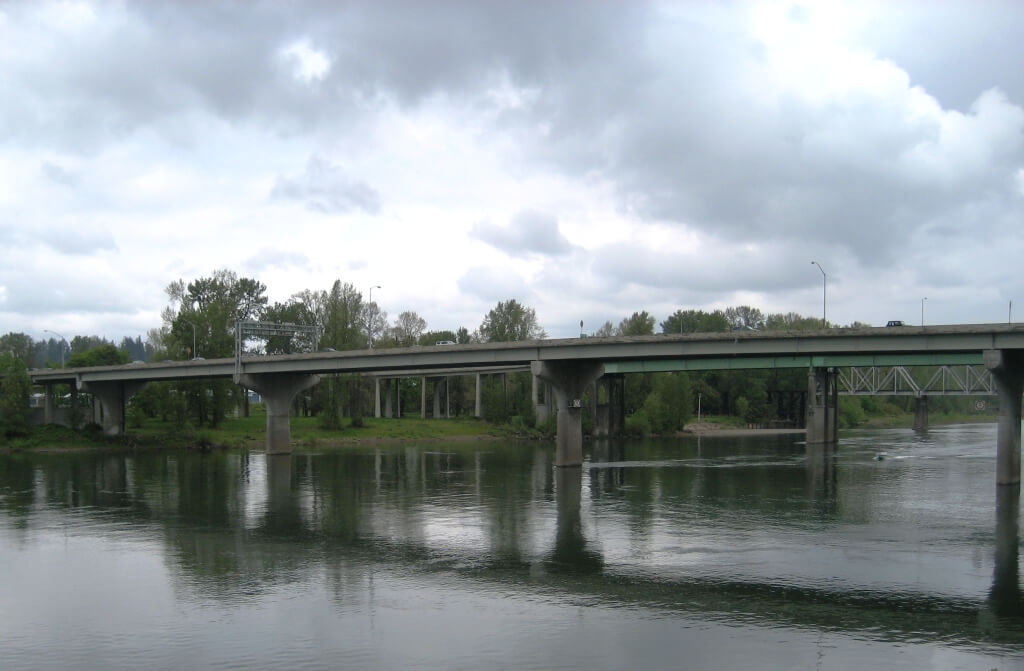
Why Center Street Bridge?
The Center Street Bridge, which carries eastbound traffic into downtown Salem, was identified as the best candidate for a retrofit because a substantial portion was replaced in 1985. Its counterpart, the Marion Street Bridge, is older and would be far more costly (perhaps impossible) to seismically reinforce.
Once the project is complete, the Center Street Bridge will be capable of supporting two-way traffic immediately following a major earthquake, providing a literal lifeline for emergency services and supplies.
Due to the bridge’s age, complex foundation issues, and the sheer scale of the required work, ODOT is tackling the project in two distinct phases.
Phase 1: The Funded Effort
Phase 1, which is fully funded with an estimated cost between $130 million and $200 million, will focus on the most crucial sections of the crossing: the river spans and the east side approach.
Key upgrades in Phase 1 include:
- Structural Strengthening: Crews will enlarge bridge supports and install massive steel piles and ground anchors into the riverbed.
- Ramp Upgrades: The project will strengthen the ramps on the east side, including the connection to southbound OR 99E (Front Street).
- Waterline Resiliency: In partnership with the City of Salem, the existing waterline attached to the bridge will be replaced with a seismically resilient pipe. This is a separate but coordinated $7 million investment to make sure West Salem retains access to water after a disaster.
- Emergency Connectivity: While the west-side ramps (Phase 2) remain unfunded, Phase 1 includes the development of an “Emergency Response Plan.” This plan will allow engineers to quickly reconnect West Salem to downtown services and I-5 in a matter of weeks or months instead of years, which is a necessary contingency in case a major earthquake takes place before Phase 2 is finished.
The bidding process for Phase 1 is currently scheduled for early 2026, with construction expected to follow immediately and continue through late 2029 or early 2030.
Phase 2: The Unfunded Gap
Phase 2, which is currently unfunded, will address the bridge’s approach ramps on the west side of the Willamette River.
Initial soil analysis revealed that the West Salem side sits on highly liquefiable soil. ODOT determined that retrofitting the existing west ramps would be less effective than replacing them entirely with new seismically sound structures.
The cost for this phase is estimated to be in a similar range to Phase 1, between $130 million and $190 million, and is pending future legislative appropriations. Planning and design for Phase 2 will happen while Phase 1 is under construction.
What Salem Residents Can Expect
While the long-term benefits are clear, the construction period will bring significant disruptions to traffic, parks, and daily life in Salem. ODOT’s goal is to minimize this disruption, but some major closures will be unavoidable.
Because much of the work involves heavy machinery and in-water drilling, residents can expect:
- Lane Closures: Periodic 24/7 closures of up to two lanes on the bridge, which could last for several months at a time.
- Full Closures: Up to four full, short-duration nighttime closures of the bridge will be necessary to install new bridge joints.
- Park Disruptions: Both Riverfront Park and Wallace Marine Park will serve as grounds for equipment staging. Parts of the northern parking lot at Riverfront Park will be closed to accommodate cranes and materials, and some tree removal will be required along the riverbanks to allow for construction access. ODOT is coordinating with the City to mitigate these impacts.
This massive seismic retrofit project is a necessary investment in Salem’s long-term safety and stability, but residents should prepare for a major overhaul of their daily commute and waterfront access starting in 2026. As ODOT moves toward breaking ground, officials are encouraging residents to sign up for project alerts to stay informed about specific traffic detours and park closures.
Links for Further Research:
- ODOT Project Page (Sign up for Project Alerts Here): OR 22: Salem Center Street Bridge Seismic Retrofit (Oregon Department of Transportation)
- City of Salem Coordination: Center Street Bridge Seismic Retrofit Project (City of Salem)
